Utilities and compatibility
Compatibility with Dask.
- genno.compat.dask.cull(dsk, keys)[source]
Like
dask.optimization.cull().This version calls
to_keylike()on the culled graph and dependencies to ensure the resulting graph does not containKey.
- genno.compat.dask.to_keylike(value)[source]
Rewrite
Keyvalue (or in value) tostr.Collections such as
tupleandlistare rewritten recursively.
- class genno.compat.graphviz.Visualizer(data_attributes: Mapping, function_attributes: Mapping, graph_attr: Mapping, node_attr: Mapping, edge_attr: Mapping, kwargs: Mapping)[source]
Handle arguments for
visualize().- add_node(kind: Literal['data', 'func'], name: str, k, v=None) None[source]
Add a data node to the graph.
- genno.compat.graphviz.unwrap(label: str) str[source]
Unwrap any number of paired ‘<’ and ‘>’ at the start/end of label.
These characters cause errors in graphviz/dot.
- genno.compat.graphviz.visualize(dsk: Mapping, filename: str | PathLike | None = None, format: str | None = None, data_attributes: Mapping | None = None, function_attributes: Mapping | None = None, graph_attr: Mapping | None = None, node_attr: Mapping | None = None, edge_attr: Mapping | None = None, collapse_outputs: bool = False, **kwargs)[source]
Generate a Graphviz visualization of dsk.
This is merged and extended version of
dask.base.visualize(),dask.dot.dot_graph(), anddask.dot.to_graphviz()that produces informative output for genno graphs.- Parameters:
dsk – The graph to display.
filename (
pathlib.Pathorstr, optional) – The name of the file to write to disk. If the file name does not have a suffix, “.png” is used by default. If filename isNone, no file is written, and dask communicates with dot using only pipes.format (
{'png', 'pdf', 'dot', 'svg', 'jpeg', 'jpg'}, optional) – Format in which to write output file, if not given by the suffix of filename. Default “png”.data_attributes – Graphviz attributes to apply to single nodes representing keys, in addition to node_attr.
function_attributes – Graphviz attributes to apply to single nodes representing operations or functions, in addition to node_attr.
graph_attr – Mapping of (attribute, value) pairs for the graph. Passed directly to
graphviz.Digraph.node_attr – Mapping of (attribute, value) pairs set for all nodes. Passed directly to
graphviz.Digraph.edge_attr – Mapping of (attribute, value) pairs set for all edges. Passed directly to
graphviz.Digraph.collapse_outputs (
bool, optional) – Omit nodes for keys that are the output of intermediate calculations.kwargs – All other keyword arguments are added to graph_attr.
Examples
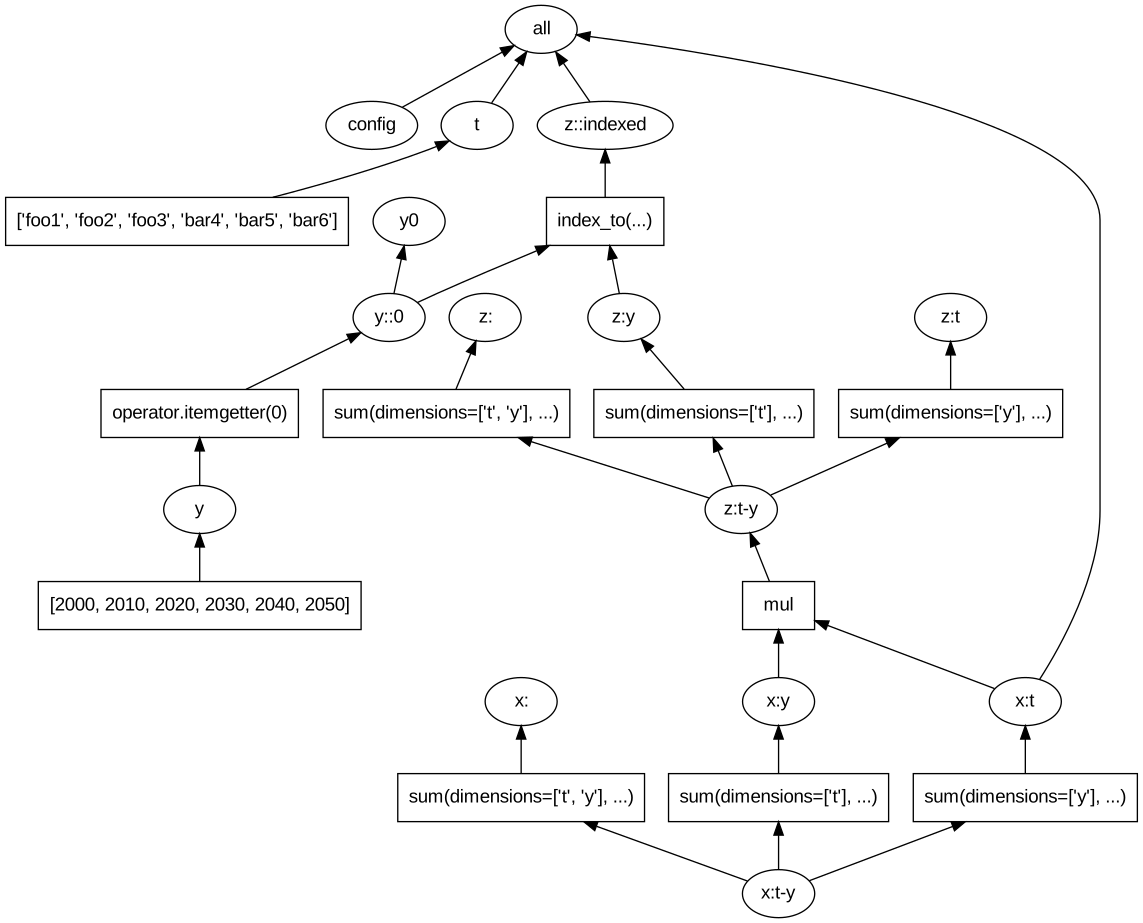
Prepare a computer:
>>> from genno import Computer
>>> from genno.testing import add_test_data
>>> c = Computer()
>>> add_test_data(c)
>>> c.add_product("z", "x:t", "x:y")
>>> c.add("y::0", itemgetter(0), "y")
>>> c.add("y0", "y::0")
>>> c.add("index_to", "z::indexed", "z:y", "y::0")
>>> c.add_single("all", ["z::indexed", "t", "config", "x:t"])
Visualize its contents:
>>> c.visualize("example.svg")
This produces the output:
See also
- genno.compat.pandas.disable_copy_on_write(name: str) Iterator[None][source]
Context manager to disable Pandas Copy-on-Write (CoW).
A message is logged with level
logging.DEBUGif the setting is changed. The fixture has no effect in pandas 3.0.0 and later, in which the option is always enabled.
- genno.compat.pandas.handles_parquet_attrs() bool[source]
Return
Trueifpandascan read/write attrs to/from Parquet files.If not, a message is logged.
- genno.compat.pandas.manager_classes() tuple[type, ...][source]
Pandas class(es) for which a fast-path
pd.Series.__init__()can be used.
- genno.compat.pandas.version() Version[source]
Return the version of
pandasas apackaging.version.Version.
- genno.core.describe.MAX_ITEM_LENGTH = 160
Default maximum length for outputs from
describe_recursive().
- genno.core.describe.describe_recursive(graph, comp, depth=0, seen=None)[source]
Recursive helper for
describe().
- genno.core.describe.is_list_of_keys(arg: Any, graph: Mapping) bool[source]
Identify a task which is a list of other keys.
- genno.core.describe.label(arg, max_length=160) str[source]
Return a label for arg.
The label depends on the type of arg:
xarray.DataArray: the first line of the string representation.functools.partial()object: a less-verbose version that omits None arguments.Item protected with
dask.core.quote(): its literal value.A callable, e.g. a function: its name.
Anything else: its
strrepresentation.
In all cases, the string is no longer than max_length.
- class genno.core.graph.Graph(*args, **kwargs)[source]
A dictionary for a graph indexed by
Key.Graph maintains indexes on set/delete/pop/update operations that allow for fast lookups/member checks in certain special cases:
unsorted_key(key)Return key with its original or unsorted dimensions.
full_key(name_or_key)Return name_or_key with its full dimensions.
These basic features are used to provide higher-level helpers for
Computer:infer(key[, dims])Infer a key.
- infer(key: str | Key, dims: Iterable[str] = []) KeyLike | None[source]
Infer a key.
- Parameters:
dims (
listofstr, optional) – Drop all but these dimensions from the returned key(s).- Returns:
str– If key is not found in the Graph.Key– key with either its full dimensions (cf.full_key()) or, if dims are given, with only these dims.
- pop(*args)[source]
Overload
dict.pop()to also call_deindex().
- unsorted_key(key: KeyLike) KeyLike | None[source]
Return key with its original or unsorted dimensions.
- update(arg=None, **kwargs)[source]
Overload
dict.update()to also call_index().
- genno.core.key.KeyLike = genno.core.key.Key | str
Type shorthand for
Keyor any other value that can be used as a key.
- genno.core.key.iter_keys(value: Key | str | tuple[Key | str, ...]) Iterator[Key][source]
Yield
Keysfrom value.See also
- genno.core.key.single_key(value: Key | str | tuple[Key | str, ...] | Iterator) Key[source]
Ensure value is a single
Key.See also
Types for hinting.
This module and its contents should usually be imported within an if TYPE_CHECKING
block.
- class genno.types.TKeyLike
Similar to
KeyLike, but as a variable that can be use to match function/method outputs to inputs.alias of TypeVar(‘TKeyLike’, ~genno.core.key.Key, str)
- class genno.types.TQuantity
Similar to
.AnyQuantity, but as a variable that can be used to match function /method outputs to inputs.alias of TypeVar(‘TQuantity’, ~genno.core.attrseries.AttrSeries, ~genno.core.sparsedataarray.SparseDataArray)
- genno.util.REPLACE_UNITS = {'%': 'percent'}
Replacements to apply to Quantity units before parsing by pint. Mapping from original unit -> preferred unit.
The default values include:
The ‘%’ symbol cannot be supported by pint, because it is a Python operator; it is replaced with “percent”.
Additional values can be added with
configure(); see units:.
- genno.util.clean_units(input_string: str) str[source]
Tolerate messy strings for units.
Dimensions enclosed in “[]” have these characters stripped.
Replacements from
REPLACE_UNITSare applied.
- genno.util.filter_concat_args(args)[source]
Filter out str and Key from args.
A warning is logged for each element removed.
- genno.util.free_parameters(func: Callable) Mapping[source]
Retrieve information on the free parameters of func.
Identical to
inspect.signature(func).parameters; that is, toinspect.Signature.parameters.free_parametersalso:Handles functions that have been
functools.partial()’d, returning only the parameters that have not already been assigned a value by thepartial()call—the “free” parameters.Caches return values for better performance.
- genno.util.parse_units(data: Iterable, registry: pint.UnitRegistry | None = None) pint.Unit[source]
Return a
pint.Unitfor an iterable of strings.Valid unit expressions not already present in the registry are defined, e.g.:
u = parse_units(["foo/bar", "foo/bar"], reg)
…results in the addition of unit definitions equivalent to:
reg.define("foo = [foo]")
reg.define("bar = [bar]")
u = reg.foo / reg.bar
- Raises:
ValueError – if data contains more than 1 unit expression, or the unit expression contains characters not parseable by
pint, e.g.-?$.
- genno.util.partial_split(func: Callable, kwargs: Mapping) tuple[Callable, MutableMapping][source]
Forgiving version of
functools.partial().Returns a partial object and leftover keyword arguments that are not applicable to func.